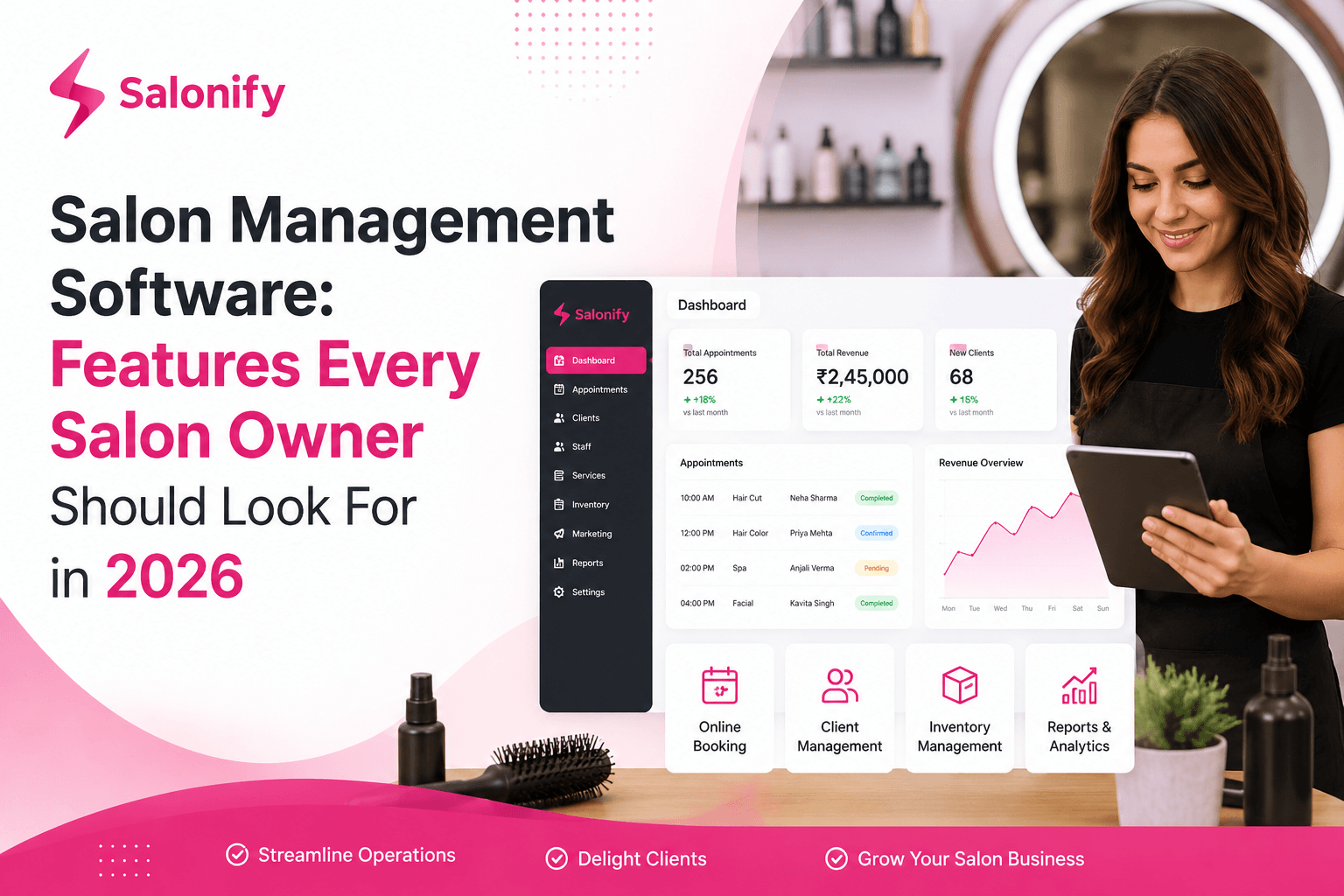
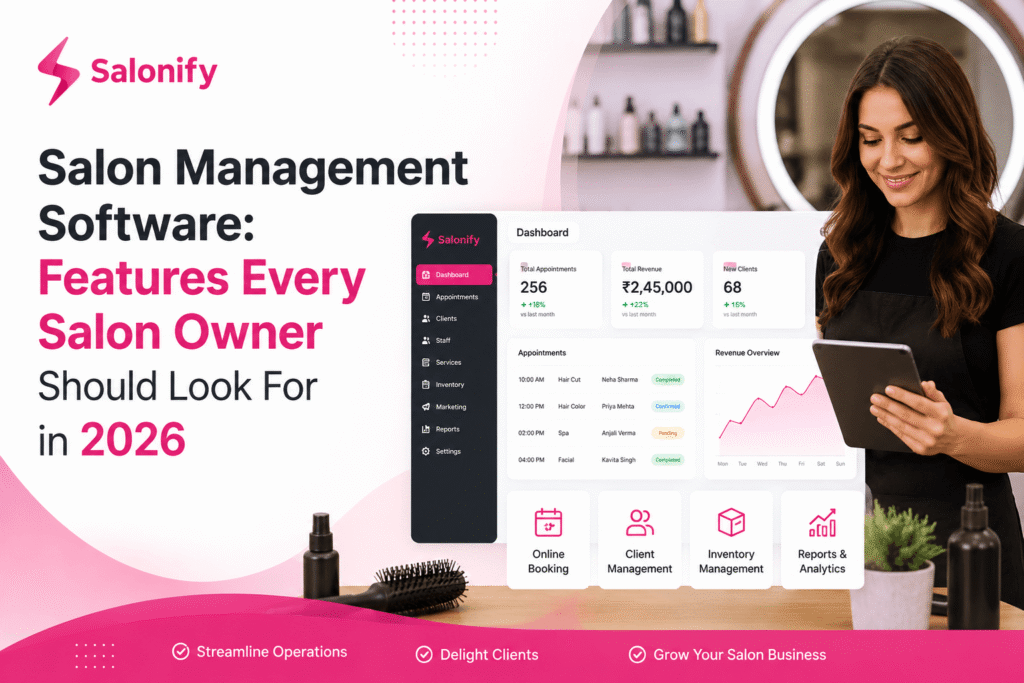
Salon Management Software: Features Every Salon Owner Should Look For in 2026
Quick Answer:
What features should every salon owner look for in management software in 2026?
The best salon management software in 2026 must include: smart appointment scheduling with conflict prevention, GST-compliant billing with UPI/QR payment support, a client CRM with visit history, membership and loyalty program management, automated WhatsApp reminders, service-linked inventory tracking, staff payroll automation, real-time analytics, digital payment integration, and multi-location dashboard control.
Key Stat: The global salon software market is growing at 9.9% annually, and 73% of Indian salons now prioritise software adoption to improve client retention.
Think about your salon during a peak Saturday morning rush. Your front desk is juggling three phone calls, two walk-ins, and a WhatsApp message from a client asking if her stylist is available at 11 AM. Meanwhile, the billing counter freezes mid-transaction because the software cannot process a UPI payment. Your best stylist has two appointments overlapping. And somewhere in the back, the shampoo you ordered three weeks ago still has not arrived because nobody tracked the stock properly.
This is not a worst-case scenario. For thousands of salon owners across India, this is Tuesday.
The global salon management software market reached $1.24 billion in 2025 and is growing at nearly 10% annually. That growth is not happening because salons are multiplying overnight. It is happening because owners who once managed everything manually have finally hit a wall, and they are looking for a smarter way out.
If you are evaluating salon management software for the first time, or considering switching from a tool that has stopped keeping up with your needs, this guide will walk you through every feature that genuinely matters in 2026, and why settling for anything less will cost you clients, revenue, and sleep.
Why Generic Software No Longer Works for Salons
Most small business owners start with a spreadsheet or a basic booking app. That may work when you’re serving only five clients a day. At thirty, it becomes chaos. Appointment conflicts appear. Billing errors pile up. Follow-ups never happen because there is no system to trigger them.
In India specifically, the challenge is compounded by market-specific requirements: GST-compliant billing, UPI and QR-based digital payments, WhatsApp as the primary communication channel, and the expectation of loyalty programs that actually reward repeat clients. Generic software built for Western markets simply does not account for these realities.
According to a 2026 industry survey, 73% of Indian salons now prioritize software adoption to improve client retention. Yet many still operate with tools that were designed for accounting firms or retail shops, not for a business where a client’s mood, trust in their stylist, and membership status all influence the next visit.
The best salon management software helps run your entire business, not just your calendar. It is the operational core of your business.
The Non-Negotiable Features in 2026
1. Smart Appointment Scheduling with Conflict Prevention
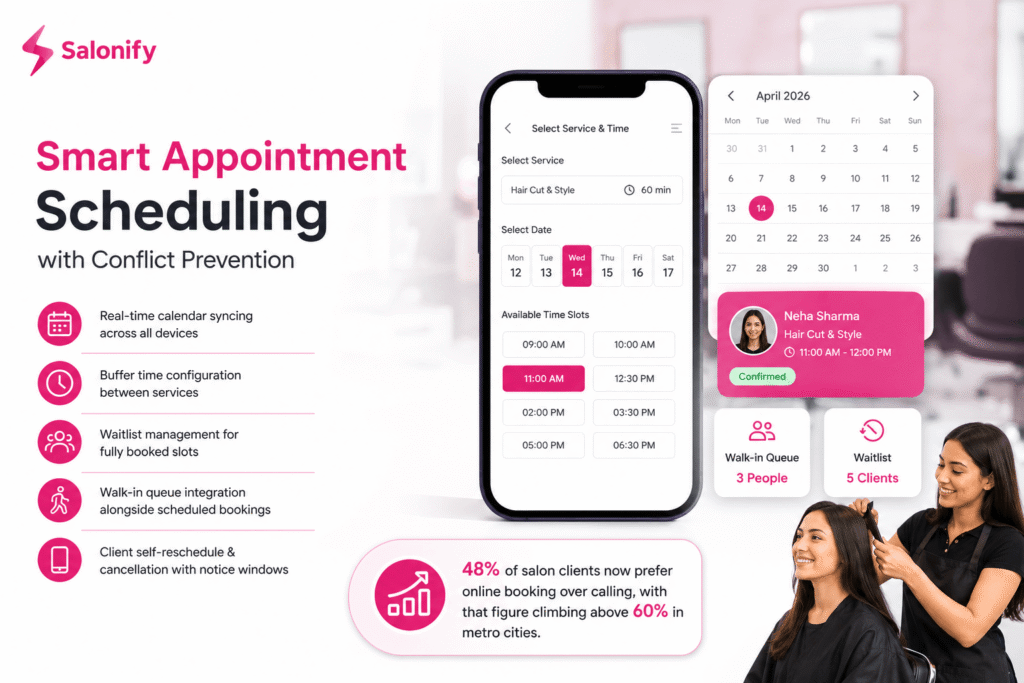
Double-bookings are one of the most common complaints salon owners share online. A proper salon appointment software should assign slots based on stylist availability, service duration, and buffer time between appointments, automatically, without human oversight.
Look for these specifics:
• Real-time calendar syncing across all devices
• Buffer time configuration between services
• Waitlist management for fully booked slots
• Walk-in queue integration alongside scheduled bookings
• Client self-reschedule and cancellation with configurable notice windows
If a client tries to book after hours and your software cannot handle it, they will book with whoever can. 48% of salon clients now prefer online booking over calling, with that figure climbing above 60% in metro cities.
2. GST-Compliant Billing and Fast POS
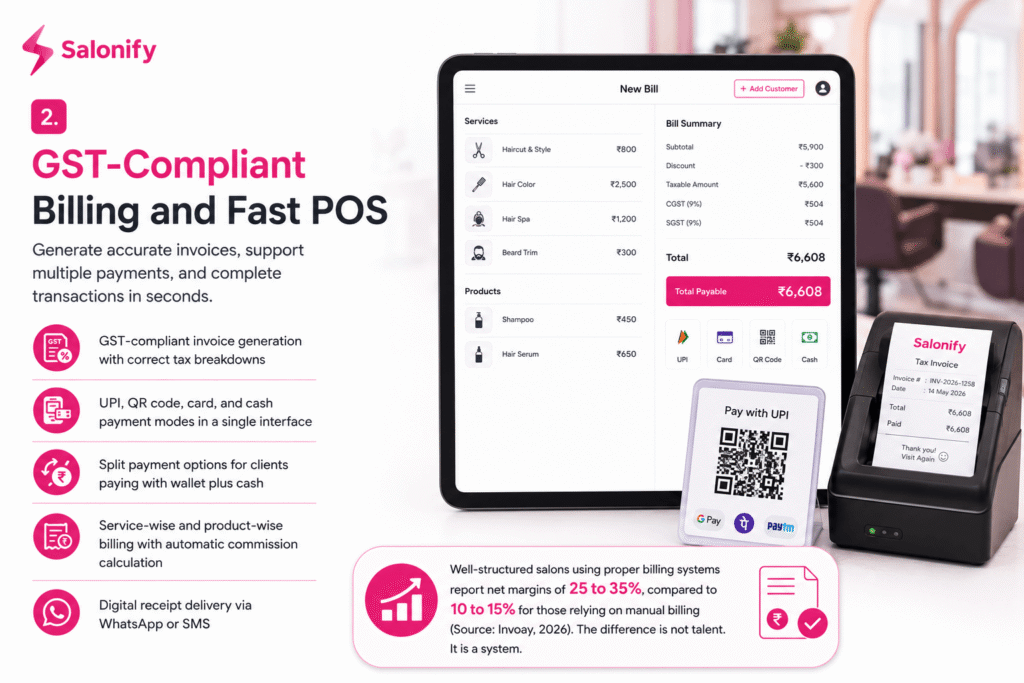
For any salon operating in India, billing software for a salon needs to do more than generate invoices. It must handle GST components correctly, support multiple payment modes, and settle transactions fast enough that a busy Saturday does not become a queue nightmare.
Your salon billing software should cover:
• GST-compliant invoice generation with correct tax breakdowns
• UPI, QR code, card, and cash payment modes in a single interface
• Split payment options for clients paying with wallet plus cash
• Service and product billing with automatic staff commission calculations
• Send digital receipts instantly via WhatsApp or SMS
Well-structured salons using proper billing systems report net margins of 25 to 35%, compared to 10 to 15% for those relying on manual billing (Source: Invoay, 2026). The difference is not talent. It is a system.
Learn how all-in-one salon billing works in practice: explore Salonify’s all-in-one salon billing features.
3. Client CRM with complete visit history and preference tracking
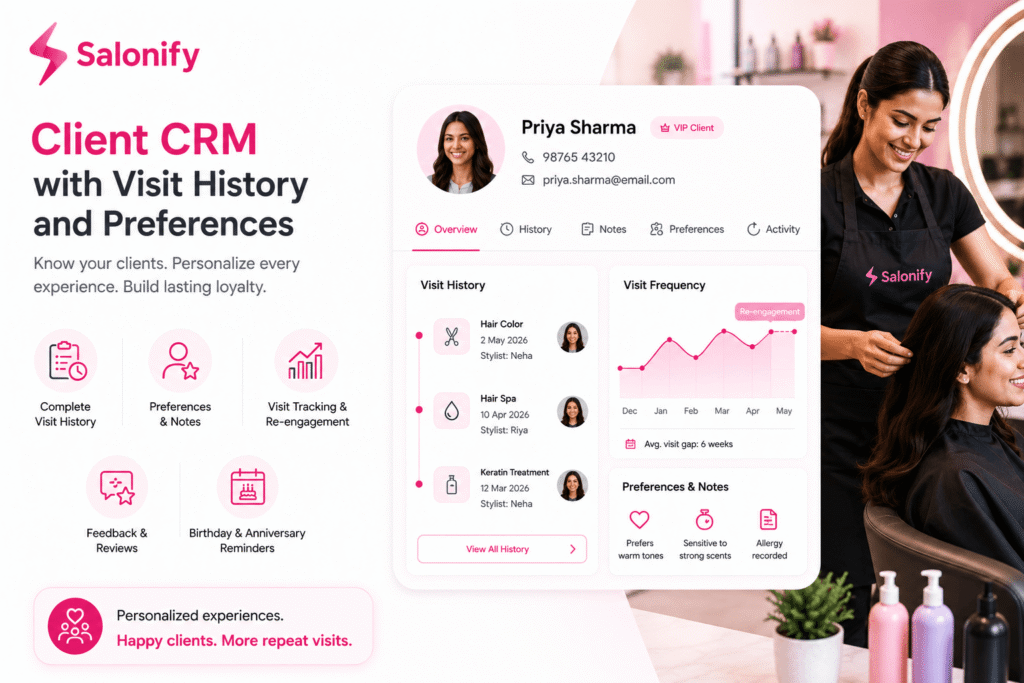
Salon CRM software is the part most owners underestimate until a client walks in and the new front desk staff has no idea she always requests the same colorist, hates strong fragrances, and last visited eight weeks ago. A strong CRM turns that guesswork into a greeting.
A well-built CRM inside your salon management system should store:
• Track every visit with service details, stylist information, and products used
• Client preferences, notes, and allergy records
• Visit frequency tracking with automated re-engagement triggers
• Feedback and review history
• Birthday and anniversary reminders for personalised outreach
4. Membership and Loyalty Program Management
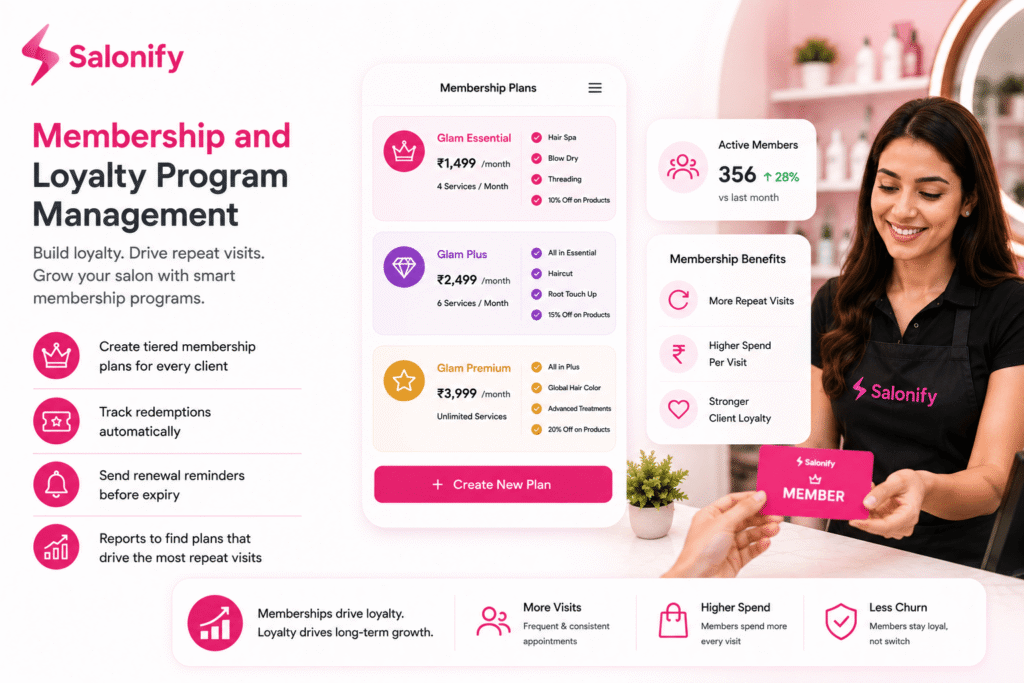
Memberships are one of the highest-ROI retention tools a salon has. A client on a monthly membership visits more frequently, spends more per visit, and is far less likely to try a competitor. But managing memberships manually through registers or WhatsApp groups is error-prone and exhausting.
Your salon membership software should let you create tiered membership plans, track redemption automatically, send renewal reminders before expiry, and report on which plans generate the most repeat visits.
5. Automated WhatsApp and SMS Communication
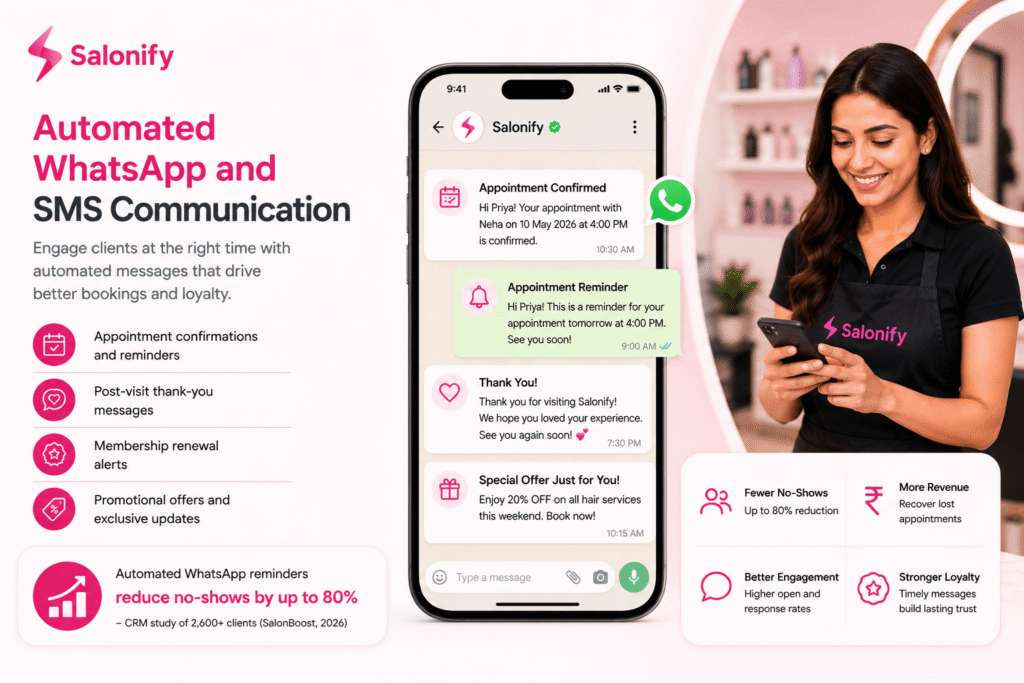
Appointment confirmations, reminders, post-visit thank-you messages, membership renewal alerts, and promotional offers all perform measurably better over WhatsApp than email or push notifications.
According to a year-long CRM study tracking over 2,600 clients, automated WhatsApp reminders helped cut appointment no-shows by as much as 80%. For a salon averaging 20 appointments daily with a 15% no-show rate and a Rs. 1,200 average ticket, that translates to over Rs. 43,000 in recovered revenue monthly from a single automation.
6. Inventory Management Tied to Services
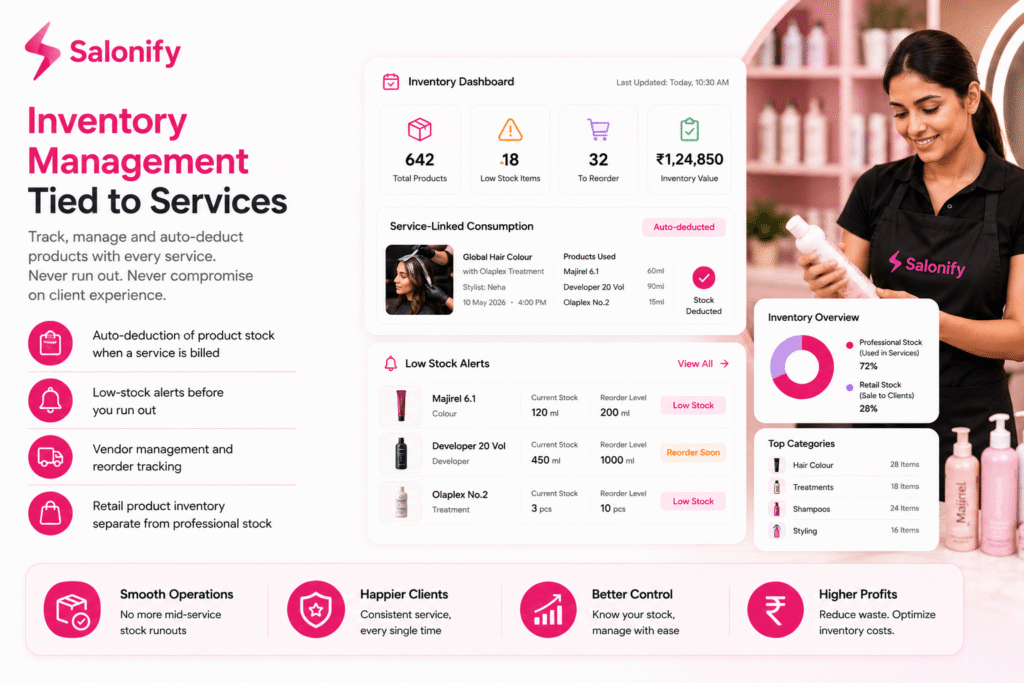
Running out of a colour product mid-appointment is not just an operational problem. It is a trust problem. Clients who experience service interruptions rarely forget them. Good hair salon software management should track product consumption at the service level, so every time a colour treatment is billed, the corresponding product quantity is automatically deducted.
Inventory features worth prioritising:
• Auto-deduction of product stock when a service is billed
• Low-stock alerts before you run out, not after
• Vendor management and reorder tracking
• Retail product inventory separate from professional stock
7. Staff Performance Tracking and Payroll
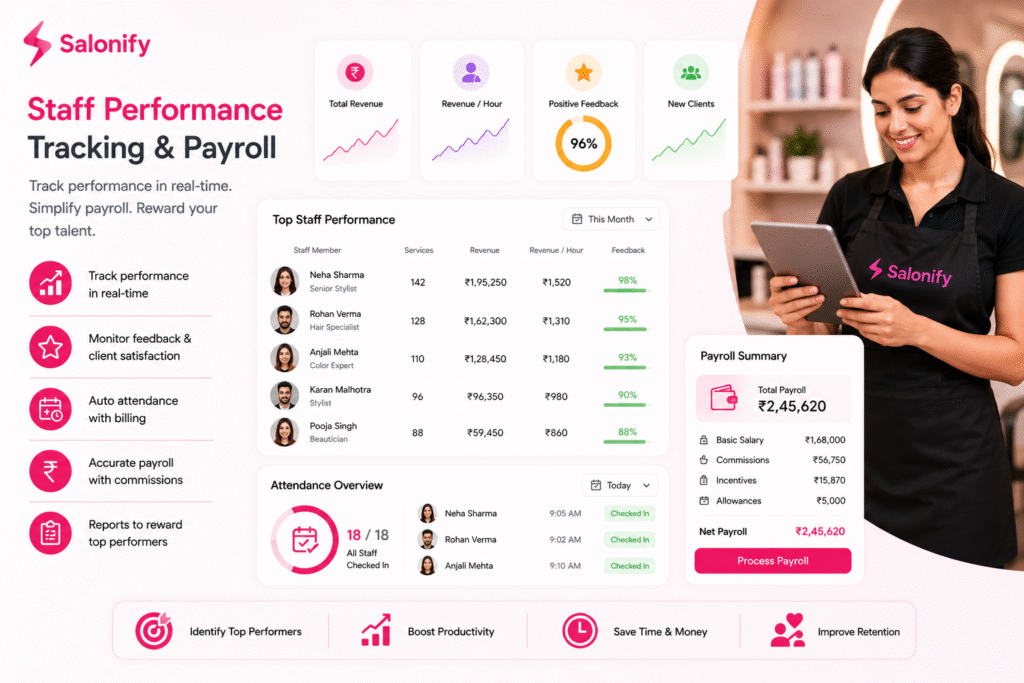
Your stylists are your product. Understanding which team members retain the most clients, generate the highest service revenue per hour, and consistently earn positive feedback lets you reward the right people and coach the rest.
Manual payroll and attendance tracking is a persistent pain point. Traditional biometric machines cost Rs. 15,000 to Rs. 25,000 and require maintenance. Modern salon management software can eliminate that entirely by logging attendance automatically when a staff member creates a bill, then feeding that data directly into payroll calculations.
8. Real-Time Analytics and Business Intelligence
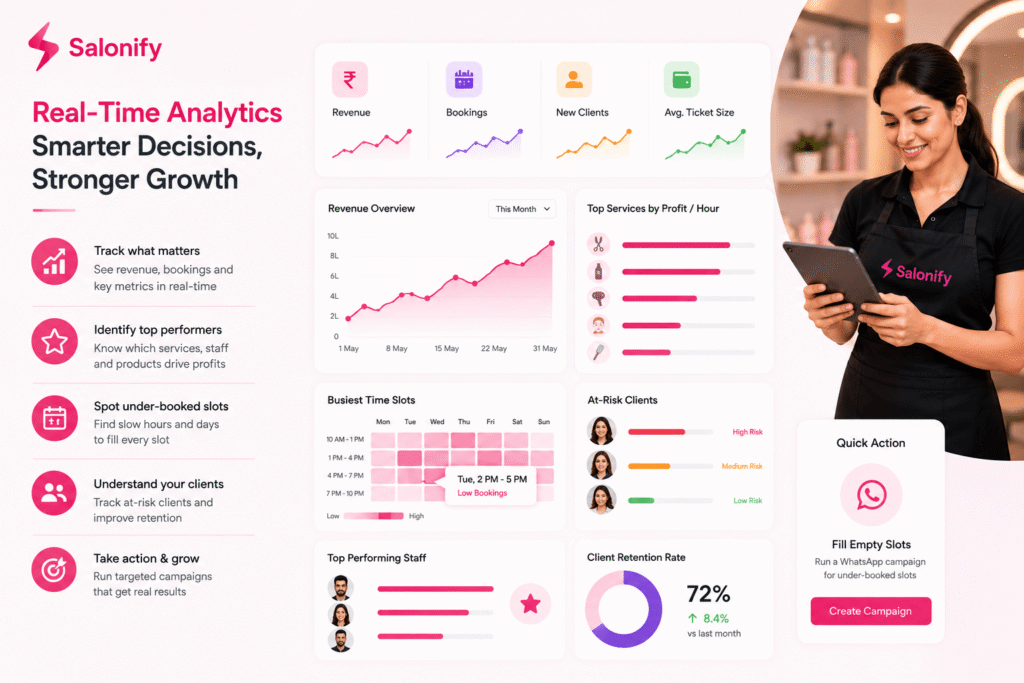
The difference between reporting and intelligence is the difference between knowing what happened and knowing what to do about it. A basic dashboard shows you yesterday’s revenue. A good analytics module tells you which services are most profitable per hour, which time slots are consistently under-booked, and which clients are at risk of churning.
Salon owners who know, for example, that their Tuesday 2 PM to 5 PM slot is consistently empty can run a targeted WhatsApp campaign to fill exactly those slots, rather than blasting generic offers to everyone.
9. Digital Payments and Contactless Checkout
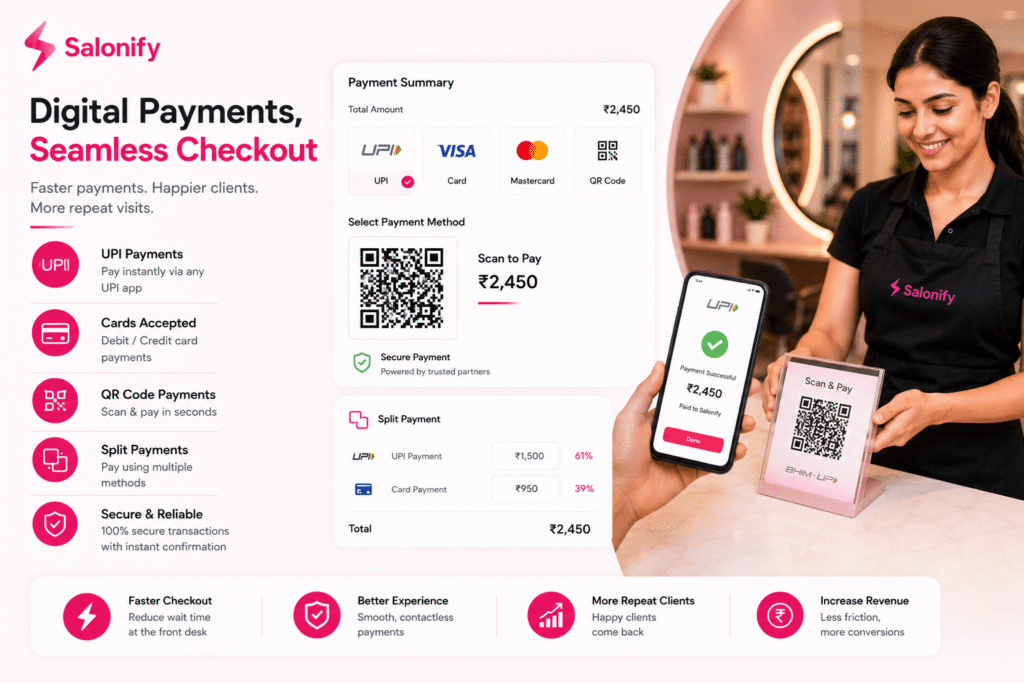
Post-pandemic client expectations around payment have not relaxed. Clients expect to pay via UPI, scan a QR code, use a card, or split payment across methods without the front desk fumbling through manual calculations. Slow checkout is one of the quieter reasons salons lose repeat clients.
• Explore how digital payment integration works for Indian salons
10. Multi-Location Management
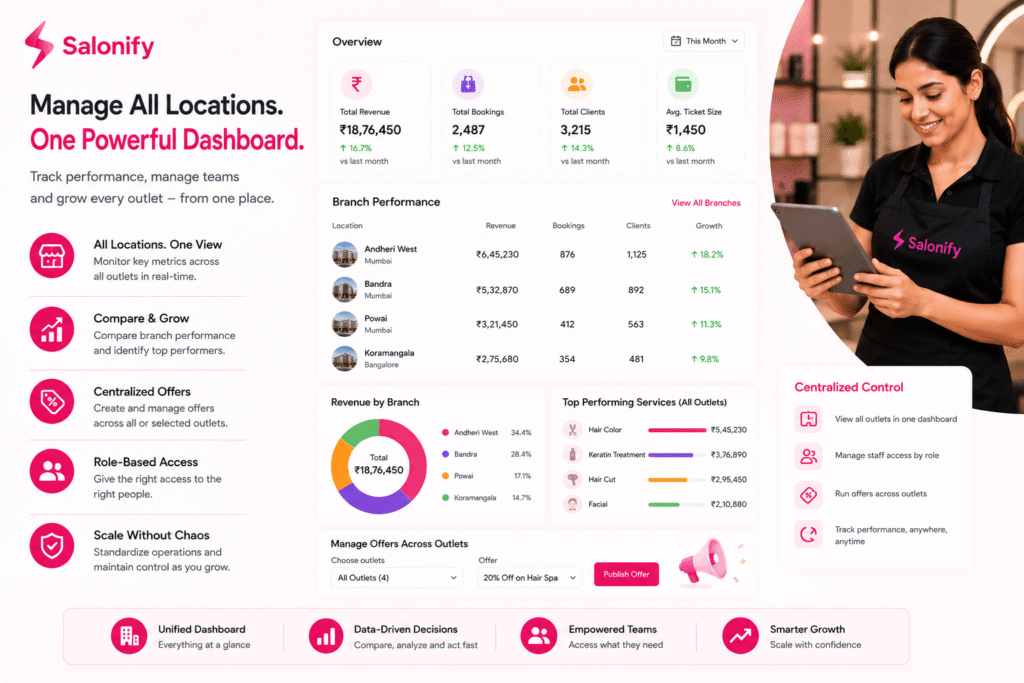
If you run more than one outlet, or plan to, your software must give you a single dashboard view across all locations. Branch-wise revenue comparison, centralised offer management, and role-based staff access are not premium add-ons. They are the baseline for any salon group trying to scale without chaos.
How Salonify Addresses the Core Problem Indian Salons Face
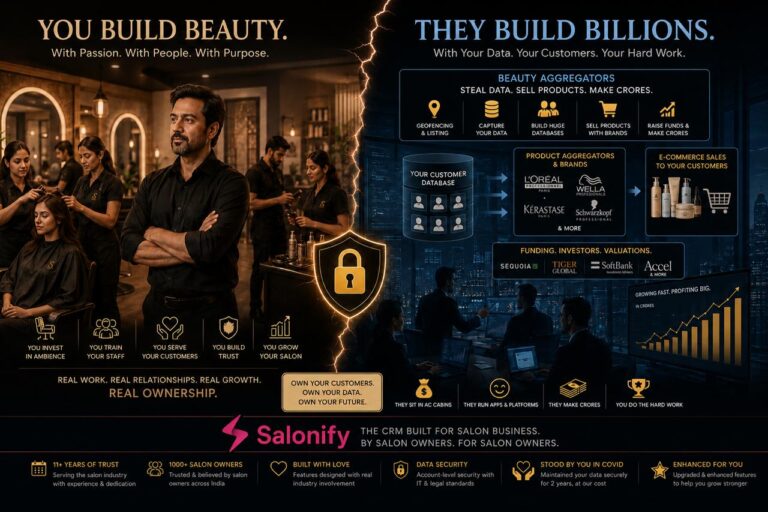
Most salon owners in India are not failing because they lack skill or dedication. They are failing because they are trying to stitch together five or six disconnected tools: a scheduling app here, a billing tool there, a WhatsApp group for client communication, and a spreadsheet for inventory. Every handoff between tools is a point where data gets lost, errors multiply, and hours disappear.
Salonify was built specifically for this problem. It brings appointment scheduling, GST-compliant salon billing software, client CRM, membership management, staff tracking, inventory, and analytics into a single platform designed for the Indian salon market. Salon owners who have made the switch report eliminating the manual reconciliation work that previously consumed hours of their week.
You can explore why salons are making the change here:
• 10 reasons salon owners are switching to Salonify for bookings
• Why salons fail at management and how AI changes that
Frequently Asked Questions
For small salons, appointment scheduling with automated reminders tends to deliver the fastest return. Reducing no-shows alone can recover significant revenue without requiring any additional marketing. GST-compliant billing is equally essential if you are operating in India, since manual billing errors create compliance risks that grow with your business
Yes, provided you choose software built for your scale. The math is straightforward: add up your monthly no-show losses, manual billing time, and any GST consultant fees. If that total exceeds the software cost, the tool pays for itself. Most single-outlet salons in India see a return within the first month of consistent use.
Billing software handles invoicing and payment processing. Full salon management software includes billing plus appointment scheduling, client CRM, inventory, staff management, loyalty programs, and analytics. For a growing salon, the CRM and scheduling components often deliver more value than billing alone, because they drive repeat visits rather than just recording transactions.
A salon CRM tracks every client’s visit history, preferences, stylist relationships, and purchase patterns. This data enables automated re-engagement when a client has not visited in a while, personalised offers on birthdays or anniversaries, and service recommendations based on past appointments. Retention built on this level of personalisation consistently outperforms generic promotional campaigns.
Yes, most modern platforms support multi-branch management from a centralized dashboard. You can compare branch-wise revenue, manage staff across locations, run unified membership and loyalty programs, and control inventory at the outlet level while monitoring overall performance from one view. This capability becomes essential the moment you open a second location.
Conclusion
As salons continue to evolve, having the right technology in place can make day-to-day operations smoother while creating a better experience for clients and staff alike.
If you’re exploring salon management solutions designed for Indian salons, platforms like Salonify offer features such as online booking, billing, customer management, marketing automation, and business analytics to help streamline operations and support growth.